
Blog
Multi-Tool vs Pocket Knife: Which Should You Carry for EDC?

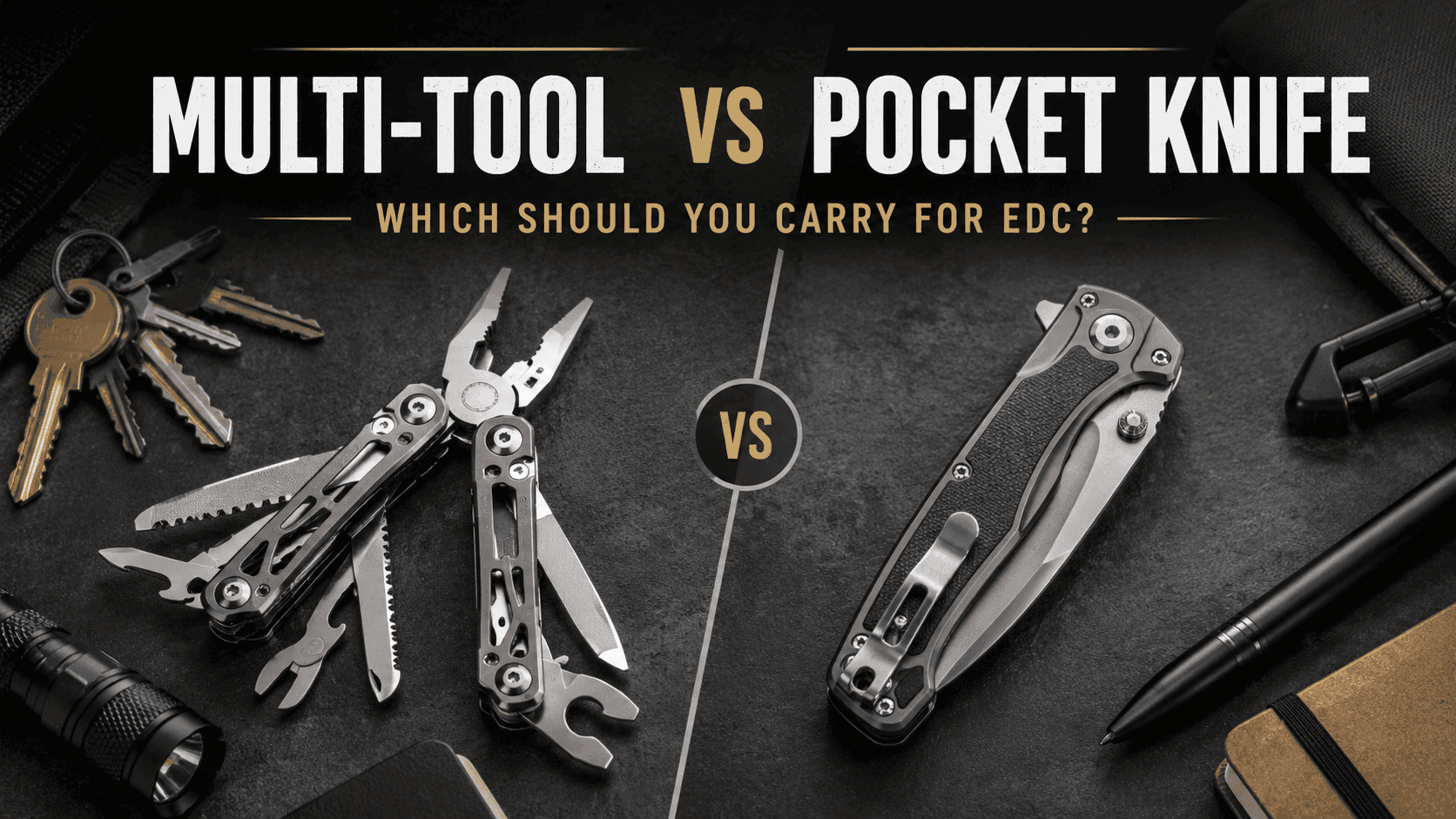
Quick answer: Choose a pocket knife when cutting is your main job and you want the slimmest, fastest daily carry. Choose a multi-tool when you regularly need pliers, screwdrivers, scissors, or small repair functions more than you need the best possible blade. If you fly with carry-on luggage, current TSA guidance makes that decision even clearer: pocket knives are not allowed in carry-ons, and multi-tools with knives are also prohibited, although bladeless multi-tools and some scissors-based tools may be allowed.
The right EDC tool is not the one with the longest feature list. It is the one that actually matches your daily tasks. Some people mostly open boxes, cut cord, and handle light utility work. Others tighten hardware, pull staples, trim loose threads, cut packaging, and deal with small fixes throughout the week. Those are different jobs, and they often point to different tools.
Tosahwi’s current blog already helps readers choose a pocket knife for everyday carry, inspect a new folder, and understand lock types. The missing question is broader: should you carry a pocket knife at all, or would a multi-tool serve you better?
Table of Contents
- What each tool is designed to do
- Multi-tool vs pocket knife comparison table
- Choose a pocket knife if cutting comes first
- Choose a multi-tool if repair tasks come first
- Travel and workplace reality
- A simple decision checklist
- How this maps to Tosahwi’s current lineup
- Common buying mistakes
- FAQ
- Methodology and editorial note
What each tool is designed to do
Pocket knife
A pocket knife is usually the better dedicated cutting tool. The handle and blade are built mainly around cutting efficiency, carry comfort, and fast access. That typically means a longer usable edge for the size, a slimmer profile in the pocket, and easier daily carry when your main tasks are packaging, food prep, cord, tape, and light utility work.
Within Tosahwi’s live lineup, pocket knives range from simpler traditional folders such as the Handmade Damascus Steel Back Lock Pocket Knife With Ebony Handle to modern one-hand folders such as the All Black Folding EDC 5 in 1 Pocket Knife.

Multi-tool
A multi-tool is usually the better problem-solving tool when cutting is only one part of the job. Pliers, screwdrivers, scissors, and small secondary implements matter more than blade length alone. The trade-off is bulk. A multi-tool often carries more weight and gives you a shorter knife blade because space is shared with the other tools.
That trade-off is visible in Tosahwi’s current multi-tool lineup. The 18-in-1 EDC Multi Tool Pliers EDC Tool With Pocket Nylon Sheath lists pliers, wire cutters, screwdrivers, scissors, a saw, and other functions, but its published blade length is 1.57 inches and its listed weight is 256 g. That is a very different carry proposition from a traditional pocket knife.

Multi-tool vs pocket knife comparison table
| Decision factor | Pocket knife | Multi-tool |
|---|---|---|
| Pure cutting efficiency | Usually better | Usually secondary to other functions |
| Pliers, drivers, small repairs | Usually weak or absent | Usually the main advantage |
| Pocket comfort | Usually slimmer and easier to forget | Usually bulkier and heavier |
| One-hand deployment | Often easier on modern folders | Varies; many are slower to access |
| Blade length for size | Usually more usable edge | Usually shorter blade for the overall footprint |
| Travel flexibility | Not carry-on friendly | Only some bladeless or scissor-only variants may work in carry-on |
| Maintenance complexity | Usually simpler | More joints, tools, and moving parts to keep clean |
| Best fit | Daily cutting and low-bulk carry | Fix-it, adjustment, and backup utility |
The table above is an editorial comparison based on current Tosahwi category pages, live product specs on the linked product pages, and general tool design. It is not a lab test.
Choose a pocket knife if cutting comes first
A pocket knife is usually the better answer when most of your real tasks are cutting tasks.
- You break down boxes, cut cord, trim packaging, and handle light utility work more often than you turn screws or use pliers.
- You want the slimmest tool that disappears into a pocket.
- You care about faster access and a longer usable edge for the amount of weight you carry.
- You prefer a tool that is simpler to clean and maintain.
- You want more choice in blade shape, lock style, carry clip, and handle feel.
For example, Tosahwi’s live pocket-knife and EDC pages currently include traditional back locks, button locks, and liner-lock folders. If you want to narrow those choices later, Tosahwi already has useful follow-up reading on knife lock types, how to inspect a new folding knife, and pocket knife maintenance.
Choose a multi-tool if repair tasks come first
A multi-tool is usually the better answer when you solve many small non-cutting problems.
- You regularly need pliers, screwdrivers, scissors, or wire-related functions.
- You work around gear adjustments, loose hardware, quick fixes, or small field repairs.
- You are comfortable carrying more weight in exchange for more function.
- Your knife blade is useful, but not the only reason the tool exists.
- You like the idea of one compact tool handling several low-intensity jobs reasonably well.
Tosahwi’s current Multi Tool category makes that positioning clear. The live category page describes pliers, screwdrivers, knives, bottle openers, and scissors as the core use case. The linked 18-in-1 model lists pliers, cutters, scissors, a saw, several drivers, and openers. The live 16-in-1 model uses cleaner current service copy and may be the more relevant page to review if you prefer a less old product template.
Travel and workplace reality
Travel rules can change what “daily carry” really means. Current TSA guidance says pocket knives are not allowed in carry-on bags. TSA also says multi-tools with knives of any length are prohibited in carry-on bags, while a multi-tool without blades may be allowed and multi-tools with scissors under 4 inches may be allowed. TSA also notes that the final decision rests with the officer at the checkpoint.
That means frequent carry-on travelers should not assume a multi-tool automatically solves the airport problem. In practice, a normal pocket knife and a normal bladed multi-tool both belong in checked baggage, not carry-on luggage. If travel is central to your use case, you may want a separate bladeless or TSA-friendlier tool instead of forcing one EDC setup to do every job.
Workplace rules matter too. Some offices, job sites, venues, and schools have their own policies even when local law may differ. This article is not legal advice. Check the actual policy or law that applies where you carry.
A simple decision checklist
- List the last ten times you used an EDC tool. If eight were cutting tasks, start with a pocket knife.
- If several of those moments involved screws, hardware, or gripping small parts, move a multi-tool higher on the list.
- Decide where you will carry it. Pocket-only carry usually favors a slimmer knife. Belt sheath or bag carry makes a multi-tool more realistic.
- Check your tolerance for weight. A tool you leave at home is the wrong tool, even if it is more capable on paper.
- Consider travel and workplace restrictions before buying around a fantasy use case.
- Choose the simpler option unless your routine clearly justifies the extra functions.
How this maps to Tosahwi’s current lineup
If your main goal is cutting performance with lower carry bulk, start with Tosahwi’s Pocket Knives or broader Everyday Carry (EDC) Knives category. If your routine includes pliers, drivers, or quick gear fixes, begin with the Multi Tool category.
A practical way to use Tosahwi’s current catalog is:
- Choose a pocket knife for the pocket if your day is mostly cutting.
- Choose a multi-tool if your day is mostly adjustment and repair.
- Carry both only if one rides in a bag, vehicle, or sheath and you know each tool has a separate job.
For deeper knife-only selection, Tosahwi’s published article on how to choose a pocket knife for everyday carry remains the better next click. For ownership after purchase, the most relevant follow-up is Pocket Knife Maintenance Checklist.
Common buying mistakes
- Buying the most feature-packed tool even though your real work is mostly cutting.
- Buying a heavy multi-tool for pocket carry and then leaving it at home because it feels bulky.
- Buying a slim pocket knife when your day regularly includes screws, clamps, or small repairs.
- Ignoring travel and workplace restrictions until after the purchase.
- Comparing marketing claims without checking the actual published dimensions, weight, and feature list.
FAQ
Is a multi-tool better than a pocket knife for EDC?
Not universally. A multi-tool is usually better for repair and adjustment tasks. A pocket knife is usually better for dedicated cutting and lower-bulk carry.
Is a pocket knife better for opening boxes and daily cutting?
Usually yes. A pocket knife normally gives you more usable edge and faster access for its size because the design is centered on cutting rather than extra functions.
Can I carry a multi-tool on a plane?
Current TSA guidance says multi-tools with knives are prohibited in carry-on bags. Some bladeless tools and some scissors-based tools may be allowed, but the final decision rests with TSA at the checkpoint. Check current TSA guidance before travel.
Can I carry a pocket knife on a plane?
Current TSA guidance says pocket knives are not allowed in carry-on baggage. They should go in checked baggage, sheathed or wrapped as appropriate.
Should I carry both a pocket knife and a multi-tool?
Only if you truly have separate jobs for them. Many people are better served by choosing one primary tool for the pocket and keeping a second tool in a bag, vehicle, or work kit.
What is the simplest rule for choosing between them?
If you cut far more than you repair, choose a pocket knife. If you repair far more than you slice, choose a multi-tool.