
Blog
Pocket Knife Maintenance Checklist: Pivot, Screws, Lubrication and Storage


Quick answer: A pocket knife stays reliable when you keep the blade and pivot clean, dry it completely, apply only a small amount of lubricant to the moving parts, check screws and clip hardware regularly, and store the knife dry. If you notice blade play, lock problems, or action issues that basic cleaning does not fix, stop using it and follow the maker’s service process.
A good folding knife does not need constant tinkering, but it does need consistent care. Pocket lint, adhesive residue, moisture, food acids, and dirty cutting tasks can all affect how a folder opens, closes, locks, and resists corrosion over time.
If you already read Tosahwi’s guide on how to sharpen a pocket knife, this article covers the maintenance habits that help you go longer between major sharpening sessions. It also pairs well with Tosahwi’s article on knife lock types, because different locks still depend on the same basic rules: clean moving parts, light lubrication, safe handling, and good judgment about when a knife needs service.
Why Pocket Knife Maintenance Matters
Most folding knives fail gradually, not dramatically. They start to feel gritty. The blade becomes slower to open. The pivot collects lint. Tape residue gets pulled into the handle. A screw loosens. A once-smooth lock starts feeling inconsistent.
That is why simple maintenance matters. Benchmade’s current care guidance says routine cleaning and light lubrication help keep knives sharp, smooth, and ready for use, and it specifically recommends mild soap, full drying, compressed air around the pivot and hardware, and only a light lubricant application to the pivot and lock areas. Spyderco likewise notes that dirt, adhesives, lint, and moisture can affect folding-knife performance and recommends cleaning the handle slot, pivot area, and lock mechanism before buildup turns into a bigger problem. CRKT also advises owners to keep knives clean, dry, lightly oiled, and in good working order.
In practical terms, maintenance helps you:
- Reduce friction and gritty action
- Lower the risk of corrosion
- Protect the pivot and lock from contamination
- Catch loose hardware before it becomes a bigger issue
- Keep the knife safer to use and easier to sharpen
Pocket Knife Maintenance Checklist
Use this checklist as a fast ownership routine:
| Task | What to check | Why it matters |
|---|---|---|
| Clean the blade | Remove tape residue, sap, food acids, dirt, and moisture | Contamination can promote rust and get pulled into the pivot |
| Inspect the pivot and lock area | Look for lint, grit, sticky residue, or visible buildup | Debris can slow the action or affect lock behavior |
| Dry the knife fully | No trapped moisture near the pivot, lock, or handle interior | Moisture increases corrosion risk |
| Lubricate lightly | Use one small drop at the pivot or moving contact points | Too little causes friction; too much attracts debris |
| Check screws and clip | Look for loosening, stripped heads, or a bent clip | Loose hardware can affect carry and blade alignment |
| Check for blade play or lock issues | Unexpected movement, incomplete lock engagement, or unusual resistance | These can signal a safety or mechanical problem |
| Store it dry | Keep it clean and dry before putting it away | Storage conditions directly affect rust and long-term wear |
Tools You Need
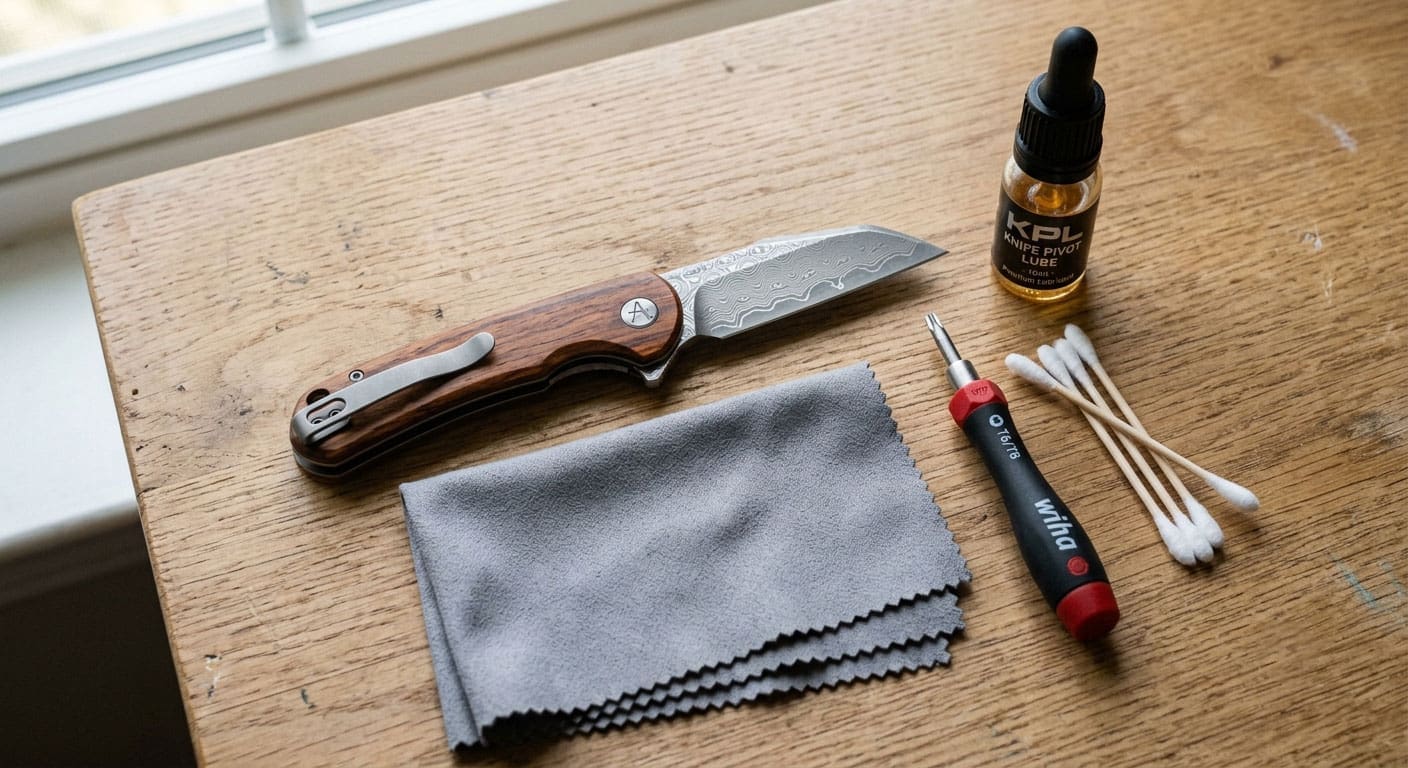
You do not need a full workshop. For most owners, this is enough:
- Microfiber cloth or lint-free cloth
- Mild dish soap
- Soft toothbrush or soft detail brush
- Cotton swabs
- Compressed air
- Rubbing alcohol for sticky residue
- Knife-safe lubricant or light mineral oil, depending on use
- Correct-size Torx driver for user-serviceable screws
If you are browsing for a daily-use folder, Tosahwi’s pocket knife collection gives you a starting point, but maintenance needs still depend more on use conditions than on price alone.
Step-by-Step Maintenance Routine
1. Wipe the blade before contamination gets worse
If you cut tape, fruit, cardboard, rope, or anything sticky, do not let that residue sit longer than necessary. Spyderco specifically warns that grime and adhesives can work their way into the pivot and handle interior on folding knives. If the blade is dirty, wipe it before you close it whenever practical.
2. Clean with mild soap when a wipe-down is not enough
Benchmade, CRKT, and Tosahwi’s own FAQ and warranty pages all recommend mild soap and water as the baseline cleaning method. Use mild dish soap, a soft cloth, and a soft brush when the blade or handle needs more than a quick wipe.
A simple rule: clean enough to remove contamination, but avoid harsh abrasives or aggressive chemicals unless the maker specifically recommends them.
3. Clear the pivot and lock area carefully
For folders, the pivot and lock area are where lint and grit usually collect. Benchmade recommends compressed air around the pivot and hardware after rinsing. Spyderco recommends compressed air, cotton swabs, and pointed non-metal tools such as a toothpick where appropriate to remove lint from lock-related recesses.
CRKT also notes that if a knife becomes difficult to open or close, the owner may need to clean around the blade pivot and inside the handle using a soft brush, dry swab, toothpick, or compressed air.
What to do:
- Open the knife carefully in a safe work area
- Brush away visible lint and grit
- Use compressed air to clear the pivot and handle slot
- Use a cotton swab or cloth for sticky residue
- Keep fingers away from the edge path throughout the process
If you are unsure how your lock operates during cleaning, review Tosahwi’s knife lock types guide and the older article on how to close a pocket knife safely before trying to manipulate the blade one-handed.

4. Dry the knife completely
This step is non-negotiable. Benchmade says to rinse thoroughly and then clear water from the pivot and hardware, while CRKT warns that leaving a knife wet or storing it damp is a reliable way to invite rust. Tosahwi’s own warranty page also says damage caused by dishwasher use or leaving the knife in damp conditions for extended periods is not covered as normal wear-free ownership.
Dry the blade, the visible hardware, and the areas around the pivot before the knife goes back into your pocket, pack, drawer, or case.
5. Apply only a small amount of lubricant
More oil is not better. Benchmade recommends light lubricant on the pivot and lock areas, then cycling the blade and wiping away the excess. Spyderco recommends one or two drops at the pivot area and warns against over-lubricating because oil attracts dust and dirt. CRKT similarly recommends a small amount of oil on the pivot or other moving parts and notes that some heavier wet lubricants can attract lint.
For most manual folders, that means:
- Apply one small drop to the pivot area
- Open and close the blade a few times
- Wipe off visible excess
If you use the knife around food, choose a food-safe option where appropriate. If the knife sees dusty pocket carry, avoid turning the pivot into a dirt magnet by over-oiling it.
6. Check screws, pivot tension, and pocket clip hardware
Routine maintenance is also a hardware check. CRKT notes that bent clips, missing screws, and simple adjustments often involve Torx fasteners and warns against over-tightening because it can strip screw heads or misalign threads.
What to check:
- Pivot screw loosening
- Pocket clip screws loosening
- Scale or body screws backing out
- Bent or snag-prone pocket clip
If a screw keeps loosening, do not guess with permanent threadlocker or force. Confirm the maker’s guidance first. If you are not sure whether a knife is meant to be owner-disassembled, the safer move is to stop at basic external maintenance.
7. Check function before carrying again
After cleaning and lubrication, confirm that the knife opens and closes normally, the lock engages consistently, and there is no new play or scraping. AKTI’s knife safety guidance emphasizes that a sharp, clean knife is a safe knife and that knives should be stored closed or otherwise safely secured when not in use.
If the knife still feels gritty or inconsistent after basic care, do not keep cycling it harder in hopes that it fixes itself.
8. Store the knife dry and clean
Tosahwi’s FAQ says to store knives in a dry place, preferably in a sheath or protective case, and its warranty page says to keep them away from moisture or extreme temperatures. Benchmade and CRKT also stress dry storage, and CRKT specifically notes that leather can trap moisture around fixed blades.
For folding knives, the practical storage rule is simple: put the knife away clean and dry, not dirty and damp.
Common Maintenance Mistakes
Using too much oil
Excess oil attracts lint, dust, and grime. A small drop is usually enough.
Closing a dirty blade into the handle
Sticky residue and grit are much easier to clean off the outside of the blade than from inside the knife.
Ignoring small hardware problems
A loose clip or screw is easier to address early than after the hardware strips, falls out, or affects blade centering.
Storing the knife wet
Even steels with decent corrosion resistance can spot, stain, or develop hidden issues if moisture stays trapped around the pivot or hardware.
Over-tightening screws
You are not improving reliability by forcing fasteners. You may only be creating stripped heads or thread damage.
Turning basic maintenance into an unplanned teardown
Benchmade recommends service when cleaning and lubrication do not resolve action issues, and CRKT explicitly tells owners to check warranty implications before fully disassembling a knife. If you do not know the model’s disassembly policy, stop at external maintenance.
When to Stop and Get Service
Basic maintenance should improve performance. If it does not, stop and escalate.
Send the knife in or contact the seller if you notice:
- Blade play that was not there before
- Lockup that looks incomplete or inconsistent
- Pivot problems that remain after cleaning and light lubrication
- A spring, button, or automatic mechanism that still malfunctions after basic care
- Stripped or damaged screws
- Cracks, chips, or damage that goes beyond normal maintenance
Tosahwi’s warranty page states that it offers lifetime free sharpening and a limited lifetime warranty against defects in workmanship and materials under normal use, while its FAQ confirms basic care expectations such as cleaning, drying, dry storage, and oiling the blade lightly. If an issue goes beyond routine cleaning, use those published support paths rather than improvising a risky repair.
Simple Maintenance Schedule
| Use pattern | Recommended routine |
|---|---|
| Light everyday carry | Quick wipe-down after dirty tasks, hardware check every few weeks, light pivot lubrication as needed |
| Heavy cardboard, tape, or work use | Wipe often, clean pivot and lock area more frequently, inspect screws weekly |
| Humid, sweaty, wet, or coastal use | Dry immediately after exposure, clean more often, monitor corrosion-prone areas closely |
| Outdoor and camping carry | Remove dirt before storage, inspect for sap and grit, touch up lubrication after cleaning |
If you want a maintenance-friendly everyday folder, it is worth comparing models by lock style, carry environment, and how easy the knife is to inspect and clean. Tosahwi’s Pocket Knives category and its lock-type guide are useful starting points for that comparison.
FAQ
How often should I clean a pocket knife?
There is no universal schedule. Clean it whenever it gets dirty, sticky, wet, or gritty. Light pocket carry may need only occasional cleaning, while work use around cardboard, tape, dust, or moisture can require much more frequent upkeep.
What oil should I use on a folding knife pivot?
Use a light knife-safe lubricant and apply only a small amount. If the knife is used around food, a food-safe option may be more appropriate. The key is not the marketing label but using a suitable lubricant sparingly and wiping away the excess.
Can too much lubricant hurt pocket-knife performance?
Yes. Excess oil can attract lint and dirt, especially in a pocket-carried folder. A little goes a long way.
Should I disassemble my pocket knife for routine maintenance?
Not by default. External cleaning, drying, compressed air, and light lubrication solve most normal maintenance needs. If the maker’s policy is unclear, or if the knife still has action or lock problems after basic care, contact the manufacturer or seller before taking it apart.
Why does my pocket knife feel gritty even after I oil it?
Because oil is not a substitute for cleaning. If lint, grit, dried residue, or contamination remains in the pivot or lock area, adding more oil may only trap the debris. Clean first, lubricate second.
Is rust prevention only important for carbon steel?
No. Non-stainless and tool steels usually need more attention, but any knife can suffer from moisture, residue, or poor storage. Dry storage and regular cleaning are good habits regardless of steel type.