
Blog
Knife Lock Types Explained: Liner, Frame, Button, Crossbar and Back Lock

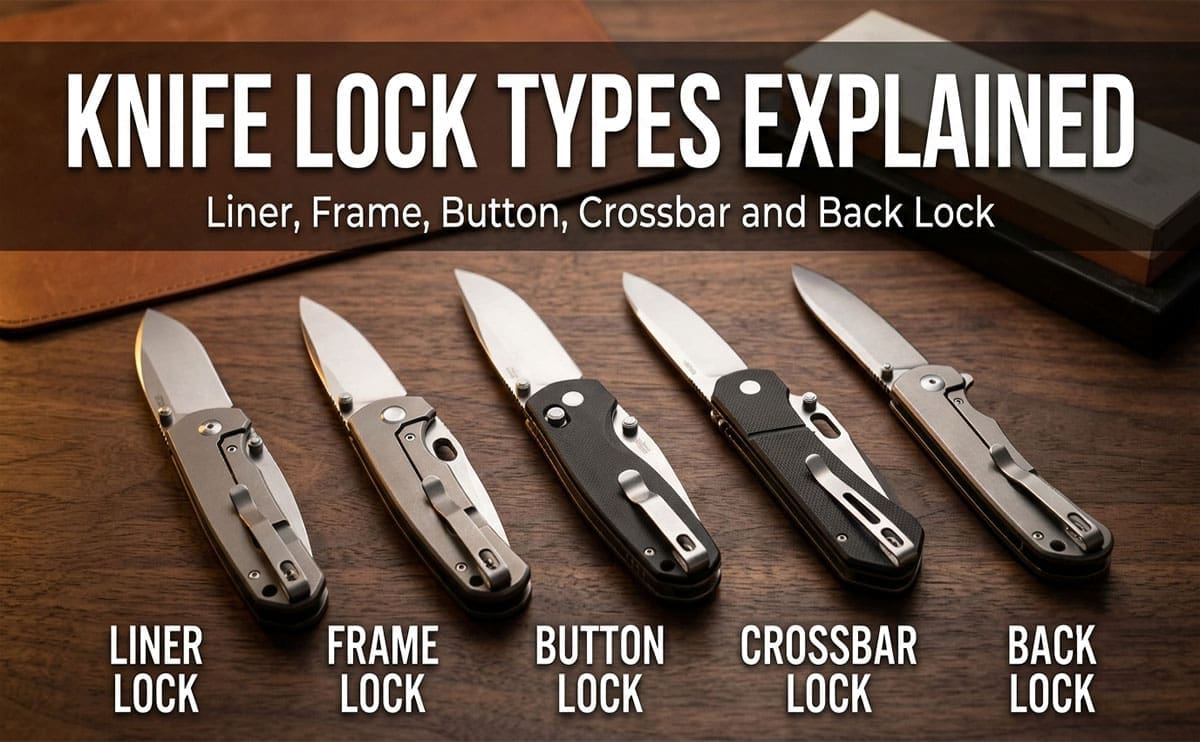
Quick answer: There is no universally “best” pocket knife lock. Liner and frame locks are simple and familiar, button locks prioritize convenient operation, crossbar locks are naturally ambidextrous, and back locks offer a traditional design with deliberate closing. The best choice depends on your dominant hand, maintenance preferences, carry environment, and how you expect to use the knife.
A folding knife lock keeps the blade in its fully open position until the user intentionally releases the mechanism. Although every lock serves the same basic purpose, the way it engages the blade tang can change how a knife feels, closes, carries, and handles with either hand.
This guide compares five common knife lock types: liner lock, frame lock, button lock, crossbar lock, and back lock. It focuses on practical ownership rather than declaring one mechanism strongest. Lock performance depends on the complete knife, including geometry, materials, manufacturing tolerances, assembly, wear, and maintenance.
How this guide was prepared: The mechanisms were compared by engagement method, hand position during closing, left-handed accessibility, maintenance needs, and typical EDC suitability. Technical definitions were checked against published guidance from the American Knife and Tool Institute and established knife manufacturers. This is a mechanism guide, not a destructive strength test.
Table of Contents
- What a folding knife lock does
- Liner lock
- Frame lock
- Button lock
- Crossbar lock
- Back lock
- Quick comparison
- How to choose
- Lock inspection and care
- Frequently asked questions
What Does a Folding Knife Lock Actually Do?
When a locking folding knife opens completely, part of the mechanism engages the blade tang and resists unintended closing. Releasing the mechanism allows the blade to rotate back into the handle. This is different from a slipjoint, which normally uses spring pressure but does not positively lock the blade open.
The American Knife and Tool Institute explains that lock-back, liner-lock, and integral or frame-lock designs use different mechanical arrangements to hold a blade in the open position. It also describes “bias toward closure,” the force that helps keep a folding blade closed when carried. These are related but separate functions.
No lock makes careless handling safe. Keep fingers away from the blade path, use the knife for controlled cutting, and stop using any folder that develops unexpected movement or fails to engage consistently.
1. Liner Lock
A liner lock uses a spring-like section of the metal liner inside the handle. When the blade reaches the open position, the liner moves laterally behind the blade tang and prevents the blade from rotating closed. Pushing the liner aside releases the blade.
Why people choose a liner lock
- Simple construction with relatively few parts
- Familiar operation on many EDC folding knives
- Supports slim handles and a wide range of scale materials
- Often easy to inspect because engagement is visible
Trade-offs
On a conventional right-handed liner lock, the thumb usually moves the liner while the blade closes through the same general area. The user must deliberately move the thumb clear before completing the close. Left-handed operation may also feel less natural unless the knife was specifically designed for it.
Best suited to: users who want a straightforward, familiar EDC mechanism and are comfortable with a deliberate closing sequence.
2. Frame Lock
A frame lock works on a principle similar to a liner lock, but a section of the handle frame itself acts as the lock bar. When the knife opens, that frame section moves behind the blade tang. It is released by pushing the lock bar away from the tang.
Frame locks are frequently paired with metal handles because the handle structure performs two jobs: it forms the frame and provides the locking element. Some designs add a steel lock-bar interface or travel stop, but construction varies by model.
Why people choose a frame lock
- Direct, easy-to-understand engagement
- Lock position is usually visible during inspection
- Integrates the lock into the structural handle frame
- Often gives a folding knife a clean, minimal profile
Trade-offs
Grip pressure can affect how freely the lock bar moves during opening or closing. As with a liner lock, the closing hand must stay aware of the blade path. A frame lock is not automatically better than a liner lock merely because its lock bar looks thicker; geometry and execution matter.
Best suited to: users who prefer metal-handled folders, visible lock engagement, and a mechanically simple design.
3. Button Lock
A button lock uses a button-operated locking component inside the handle. Pressing the button disengages the lock so the blade can rotate. The button is the user interface, but the exact internal geometry can differ between manual, assisted, and automatic knives.
That distinction matters: a button lock does not automatically mean a knife is automatic. Some manual folding knives use a button only to release the lock, while opening still requires a thumb stud, flipper, or other manual action.
Why people choose a button lock
- Convenient release without pressing a liner or frame bar
- Can keep fingertips farther from the closing edge path
- Fast, intuitive operation after basic familiarization
- Works well on many modern EDC designs
Trade-offs
The mechanism contains internal surfaces that should be kept free of grit and sticky residue. Button placement and spring pressure vary, so one model may feel very different from another. Local laws can also treat automatic opening mechanisms differently from manual button-lock folders; check the actual opening system rather than relying on the word “button.”
Best suited to: users who prioritize convenient one-handed closing and modern EDC operation.
See examples in the Tosahwi pocket knife collection, including the Tosahwi titanium-handle button lock pocket knife.
4. Crossbar Lock
A crossbar lock uses a spring-loaded bar that moves across the handle and engages the blade tang. Pulling the bar back from either side releases the blade. The operating tabs are normally accessible from both sides of the handle.
Why people choose a crossbar lock
- Naturally suited to right- or left-handed operation
- Allows the lock to be released away from the blade edge
- Popular for modern EDC and outdoor folding knives
- Offers a distinct, easy-to-locate control
Trade-offs
Crossbar systems depend on internal springs and moving components. Dirt, dried lubricant, or a damaged spring can affect operation. Owners should inspect both sides of the mechanism and follow the manufacturer’s maintenance guidance rather than flooding the lock with oil.
Best suited to: left-handed users, people who switch hands during work, and buyers who want an ambidextrous lock release.
5. Back Lock
A back lock, also called a lockback, uses a rocker or spring bar along the spine of the handle. A projection on the bar engages a notch in the blade tang when the knife opens. Pressing the exposed section of the bar lifts it from the notch and releases the blade.
Why people choose a back lock
- Long-established mechanism with a traditional feel
- Lock release is positioned on the handle spine
- Common on hunting and classic pocket knife patterns
- Encourages a controlled, deliberate closing motion
Trade-offs
Many back locks are easiest to close with two hands, although placement and technique vary. Debris in the tang notch can prevent full engagement, so the locking surfaces should be checked and kept clean.
Best suited to: users who value traditional construction and do not need the fastest one-handed closing method.
Knife Lock Types: Quick Comparison
| Lock type | Release location | Left-hand friendliness | Closing style | Typical fit |
|---|---|---|---|---|
| Liner lock | Inside handle | Usually right-hand biased | Deliberate one-handed or two-handed | General EDC |
| Frame lock | Handle frame | Usually right-hand biased | Deliberate one-handed or two-handed | Metal-handle EDC |
| Button lock | Handle button | Depends on placement | Convenient one-handed release | Modern EDC |
| Crossbar lock | Both sides of handle | Excellent | Ambidextrous one-handed release | EDC and outdoor use |
| Back lock | Handle spine | Generally neutral | Often deliberate or two-handed | Traditional and hunting folders |
How to Choose the Best Knife Lock for You
Choose for your dominant hand
Left-handed buyers should look beyond marketing words such as “one-handed.” Check whether the lock release, opening control, and pocket clip can all be operated comfortably from the left side. A crossbar lock is usually the easiest starting point, but an appropriately configured button or back lock may also work well.
Choose for your working environment
If the knife will encounter sand, lint, sap, or food residue, prioritize a mechanism you can inspect and clean according to the manufacturer’s instructions. Simple construction can be valuable, but every pivot and lock still requires basic care.
Choose for the way you close a knife
Some users prefer a slow two-handed close; others need convenient one-handed operation. Try to evaluate the full hand movement, not just the release control. Your fingers should be able to move clear before the edge enters the handle.
Choose the complete knife, not only the lock name
Handle shape, blade length, pocket clip, opening method, weight, tolerances, and lock geometry all affect the ownership experience. Two knives using the same general lock type can feel substantially different.
How to Inspect and Maintain a Folding Knife Lock
- Open the knife normally. Confirm that the lock engages consistently without forcing the blade.
- Inspect visible engagement. Look for debris, damage, or obviously incomplete engagement.
- Check gently for unexpected movement. Do not strike the spine or perform improvised destructive tests.
- Close it slowly. Learn where every finger sits before attempting faster one-handed operation.
- Keep the mechanism clean. Remove pocket lint and grit with methods approved for the model.
- Stop if behavior changes. Unexpected slipping, sticking, excessive movement, or inconsistent engagement deserves professional inspection.
Never use a folding knife lock as permission to pry, twist, hammer, or apply loads the knife was not designed to handle. A lock is one part of a cutting tool, not a guarantee against misuse.
Our Practical Recommendation
For a first EDC folder, a well-made liner lock provides simple, familiar operation. Buyers who prefer metal handles may like a frame lock. A button lock is attractive when convenient closing is the priority. Left-handed users should start with a crossbar lock or another genuinely ambidextrous design. A back lock remains a strong choice for people who prefer traditional operation and deliberate handling.
Browse folding blade knives or compare the broader pocket knife collection by lock type, opening method, handle material, and intended use.
Frequently Asked Questions
What is the strongest pocket knife lock?
A lock name alone does not determine strength. Geometry, materials, heat treatment, tolerances, assembly, wear, and the complete knife design all matter. Choose a reputable, well-executed knife for its intended cutting tasks rather than relying on generalized strength claims.
Is a button lock knife automatic?
Not necessarily. A manual folder may use a button to release the lock while still requiring manual blade opening. Automatic knives use stored energy to deploy the blade after a control is activated. Check the specific opening mechanism and applicable local laws.
Is a liner lock safe?
A properly made, maintained, and correctly used liner lock can be suitable for everyday cutting. Keep fingers clear during closing and stop using the knife if the lock fails to engage consistently or develops unexpected movement.
Which knife lock is best for left-handed users?
Crossbar locks are commonly ambidextrous because the release is accessible from both sides. Some button locks and back locks also work well for either hand. Pocket-clip position and opening controls should be evaluated at the same time.
What is the difference between a frame lock and a liner lock?
A liner lock uses an internal metal liner as the lock bar. A frame lock uses part of the handle frame itself. Both generally move laterally behind the blade tang, but their construction and handling can differ.
One thought on “Knife Lock Types Explained: Liner, Frame, Button, Crossbar and Back Lock”