
Blog
Knife Grind Types Explained: Full-Flat, Hollow, Scandi, Convex and More

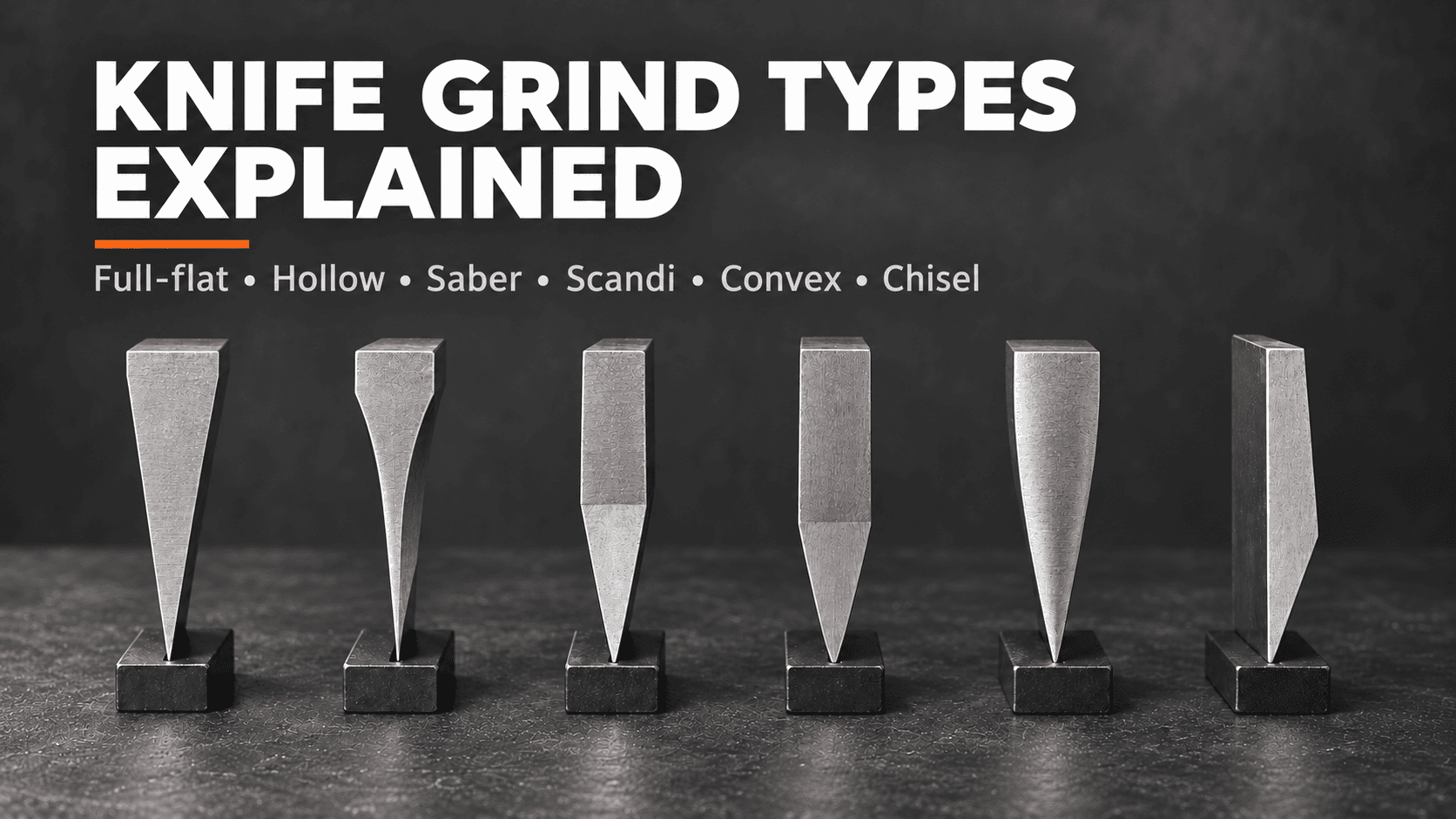
Quick answer: A knife grind is the shape created as the blade tapers toward its cutting edge. For broad everyday use, a well-executed full-flat grind is a versatile starting point. Hollow grinds can cut thin material efficiently; Scandi grinds are easy to index on a stone and are closely associated with woodcraft; convex grinds leave more material supporting the edge; and chisel grinds favor specialized cutting. Grind labels are only a starting point: blade stock, grind height, thickness behind the edge, edge angle, steel, and heat treatment also affect performance.
Table of Contents
What Is a Knife Grind?
A knife grind describes the cross-sectional geometry produced when material is removed from the blade faces toward the edge. Imagine looking straight at the blade from the point: the sides may taper in straight planes, curve inward, curve outward, or be beveled mainly on one side.
This geometry influences how readily the blade enters and moves through material and how much steel supports the edge. It does not work alone. Two knives carrying the same grind label can behave differently because their blade thickness, grind height, edge angle, and thickness immediately behind the edge differ. Controlled cutting research likewise identifies geometry and sharpening as major contributors to cutting behavior; steel name alone does not tell the whole story. See Knife Steel Nerds’ discussion of sharpness versus cutting ability.
Knife Grind vs. Edge Bevel: Do Not Confuse Them
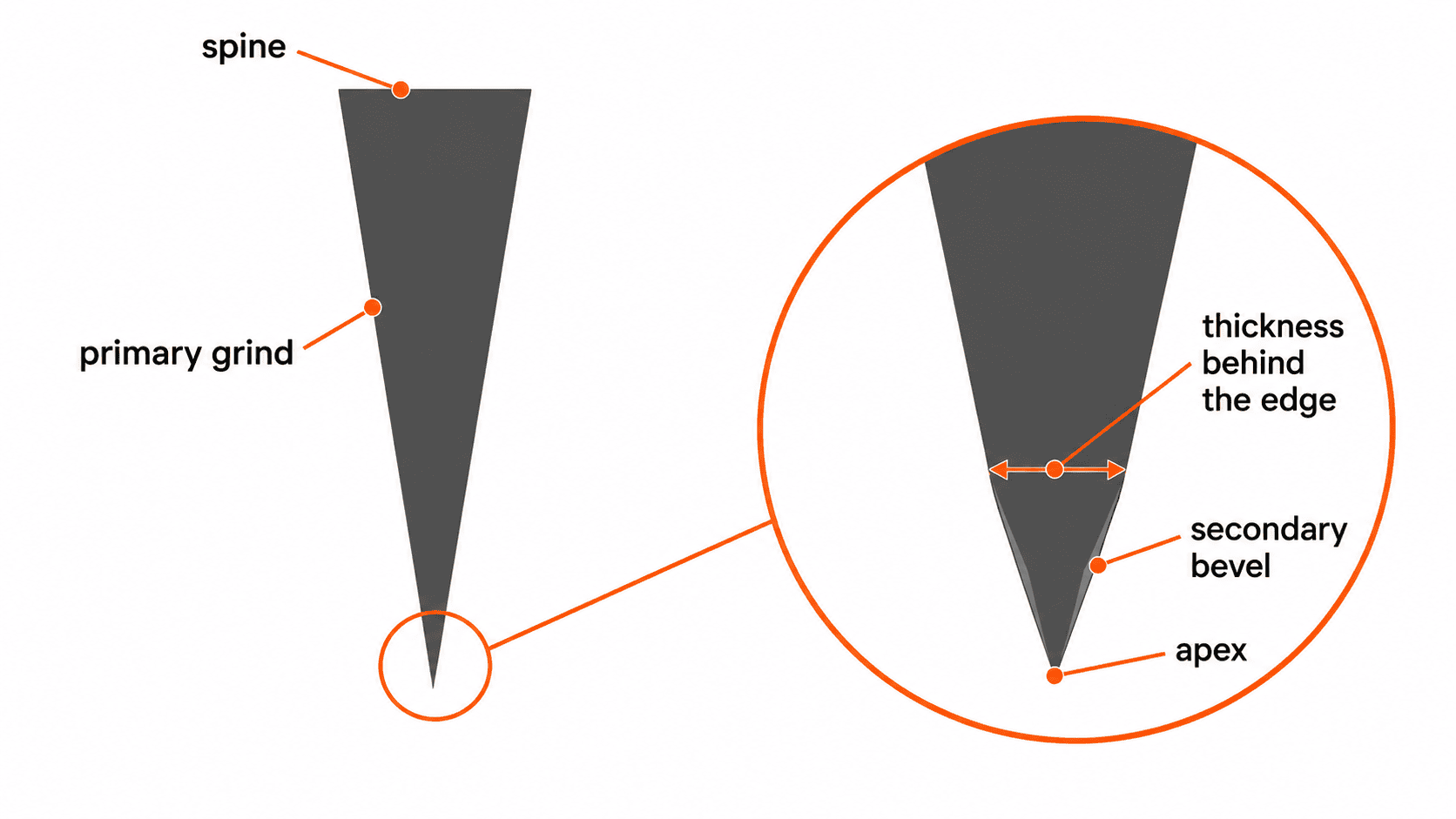
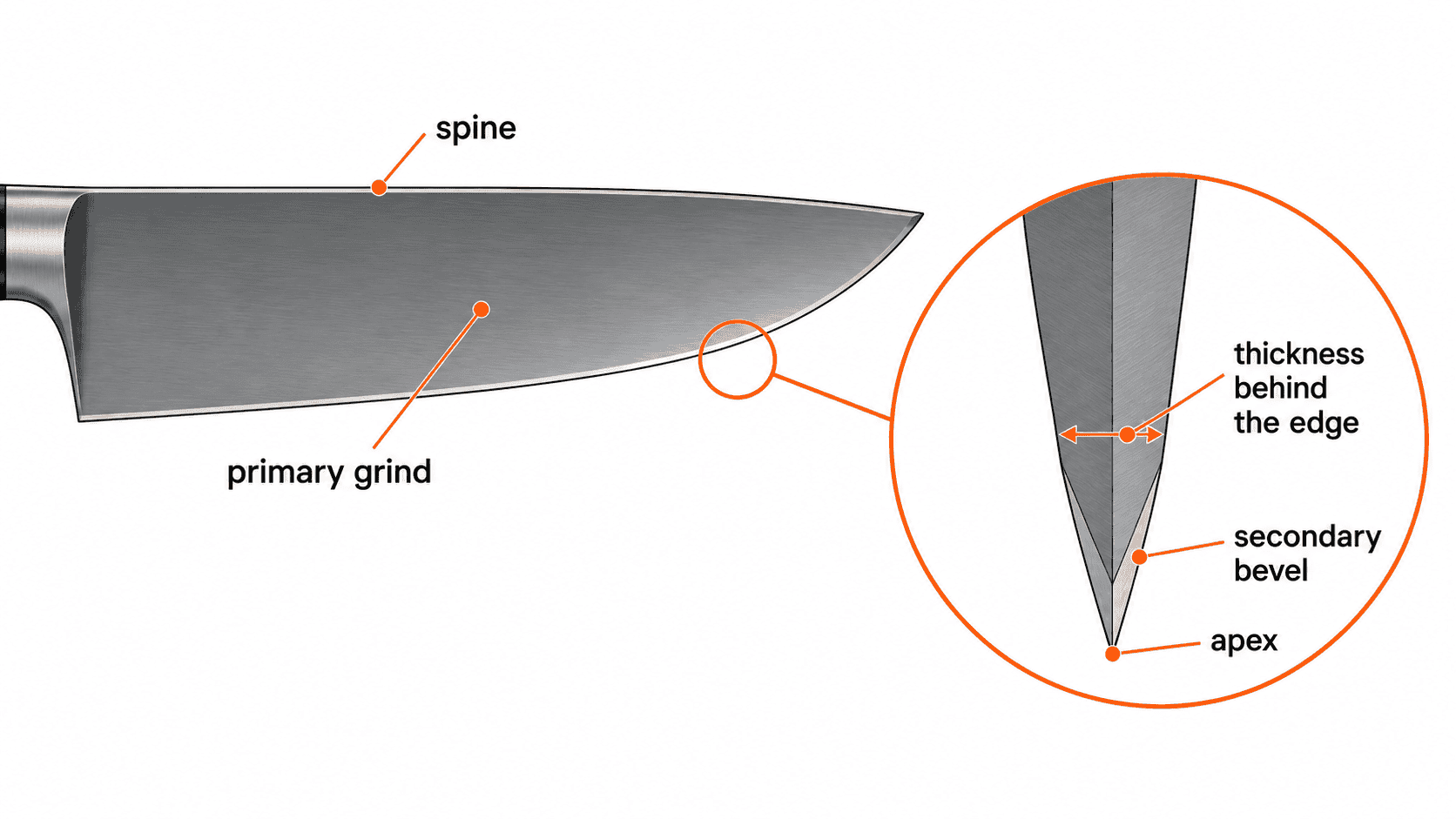
The primary grind shapes most of the blade below the spine. The smaller bevel at the very edge is commonly called the secondary bevel or edge bevel. A product may therefore have a flat primary grind and a V-shaped secondary edge. Tosahwi’s drop-point folding pocket knife, for example, currently describes its sharpening method as “flat, Secondary V-edge.” That is more informative than a single grind label, although buyers should still confirm any specification that matters before ordering.
A zero grind is different: the main bevel continues to the cutting edge without a separate secondary bevel. The official Spyderco grind glossary distinguishes full-flat, hollow, single-bevel, zero, and zero-ground saber/Scandi geometries in this way.
Knife Grind Types Compared
| Grind | Cross-section | Common strength | Common tradeoff | Good starting use |
|---|---|---|---|---|
| Full-flat | Straight taper from spine toward edge | Balanced cutting through deeper material | Performance varies greatly with stock and edge thickness | EDC, food prep, general utility |
| Hollow | Concave blade faces | Can be thin near the edge | Blade may widen more abruptly above the hollow | Controlled slicing and skinning |
| Saber / flat saber | Straight bevel begins below the spine | Leaves more full-thickness material above the grind | May wedge more in deep cuts | General utility and robust designs |
| Scandi | Low flat zero bevel, usually no secondary bevel | Easy bevel registration; strong woodcraft control | Less efficient for some deep food cuts | Carving and bushcraft |
| Convex | Outward-curving taper | Gradual transition with material behind the edge | Exact angle is harder to read on a flat stone | Outdoor and harder-use cutting |
| Chisel / single bevel | Primary bevel mainly on one side | Task-specific cutting and simple geometry | Can steer in material; handedness may matter | Specialized utility or culinary work |
These are tendencies, not guarantees. Compare actual dimensions and intended use rather than ranking grind names in isolation.
Common Knife Grinds Explained
Full-Flat Grind
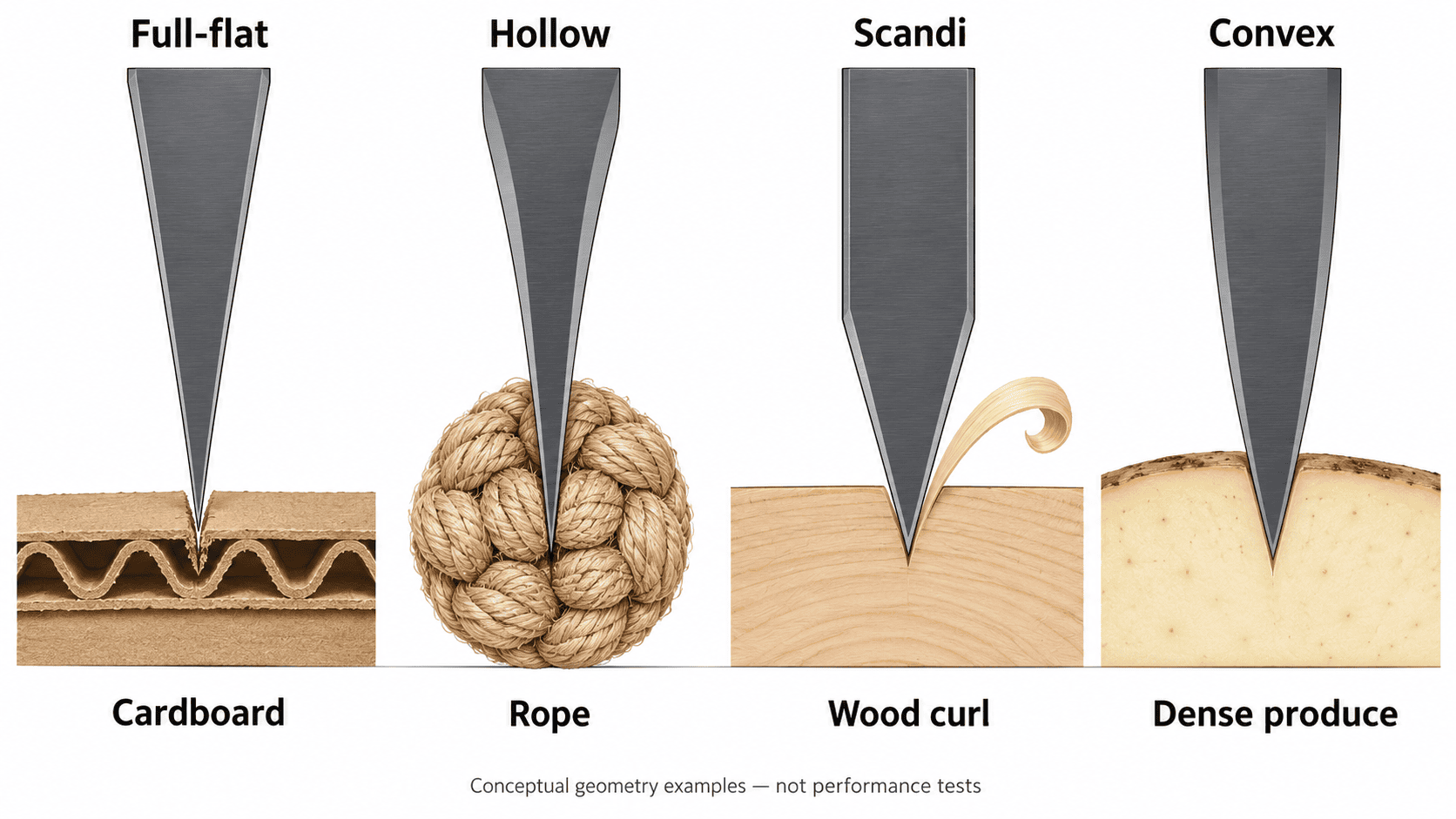
On a full-flat grind, flat bevels run from the spine toward the cutting edge. Because thickness increases progressively across much of the blade height, this layout is a strong all-purpose choice for cardboard, food, cordage, and other cuts that may engage a large part of the blade face. It is not automatically “thin”: thick blade stock or a thick edge can still make a full-flat blade wedge.
Hollow Grind
A hollow grind uses concave bevels, traditionally produced on a wheel. It can leave a fine section near the edge while retaining thicker material higher on the blade. This can work well when initiating controlled slices. In deeper, dense material, the transition to the thicker portion may add resistance. The radius, grind height, stock thickness, and final edge geometry all matter, so “hollow” does not by itself prove superior sharpness.
Saber Grind
A saber grind begins partway down the blade rather than at the spine. The bevel itself may be flat or hollow, which is why “saber” and “hollow” are not always mutually exclusive labels. A flat saber grind keeps more of the blade at full thickness above the grind line. That can suit robust utility designs, though a low, thick grind may meet more resistance in deep cuts.
Scandi Grind
A Scandinavian, or Scandi, grind is commonly a low flat bevel that continues to the edge without a separate secondary bevel. The broad bevel can be laid against a sharpening stone, making the angle easier to register. It is popular for carving because the bevel helps the user control wood cuts. The Tosahwi camp knife guide also identifies Scandi grinds with bushcraft-focused carving, while noting that other geometries may be more versatile for mixed camp tasks.
Convex Grind
A convex grind curves outward as it approaches the edge, creating a smooth transition rather than a flat or hollow face. Designers can use that transition to retain support behind the cutting edge. Convex geometry is often considered for outdoor knives expected to meet tougher material, but it is not damage-proof and it does not authorize prying, twisting, or striking unless a manufacturer explicitly approves those uses.
Chisel or Single-Bevel Grind
A chisel grind is beveled primarily on one side. It is common in specialized tools and some culinary knives. The asymmetry can affect the direction a blade tracks through thick material, and left- versus right-handed suitability may matter. Buyers should distinguish a true single-bevel primary grind from an ordinary double-bevel knife that has merely been sharpened unevenly.
How to Choose the Right Knife Grind
For Everyday Carry and Package Opening
Start with predictable daily tasks, not a claim that one grind is best. A reasonably thin full-flat or hollow-ground blade can work well for tape, packaging, cord, and light utility. Then compare closed size, lock, edge type, and carry setup in Tosahwi’s pocket knife selection guide and browse the EDC knife category. Verify the individual listing because category copy is not a substitute for model-level specifications.
For Camping and General Outdoor Work
For food, rope, and light wood preparation in one tool, a full-flat or moderate convex grind is a practical starting point. For carving-first use, consider Scandi. Construction, handle security, sheath retention, corrosion resistance, and blade dimensions remain equally important. Tosahwi’s fixed-blade collection provides a place to compare available formats, while the individual product page should supply the decisive details.
For Food Preparation
Thin geometry generally matters more than a fashionable grind name. A thin full-flat blade can move through tall produce with less abrupt widening, while a thick outdoor blade may split food even if its edge is sharp. Use a dedicated food-contact knife when hygiene and cross-contamination matter, and follow Tosahwi’s kitchen knife category with careful model-by-model review.
For Woodcarving
Scandi geometry is an intuitive choice for controlled carving, but a thin full-flat or convex edge can also carve effectively. Match the knife to the cuts you actually make. Do not assume that every outdoor knife is designed for batoning or impact work.
A Five-Point Buying Checklist
- Name the main material: cardboard, food, rope, hide, or wood.
- Check the whole geometry: blade stock, grind height, behind-edge thickness, and edge angle where published.
- Confirm construction: fixed or folding, lock type, handle, and sheath or clip.
- Plan maintenance: decide whether you can reproduce the edge with your sharpening tools.
- Verify the listing: ask Tosahwi to confirm missing or conflicting specifications before purchase.
How Grind Type Changes Sharpening
Most knives with a secondary V-edge are maintained at that small edge bevel rather than by removing material across the entire primary grind. A Scandi zero bevel is often laid flat on a stone, while convex edges are commonly maintained with a method that preserves their curve. Chisel grinds require attention to the maker’s intended beveled side and deburring method.
Do not infer a sharpening angle from grind type. Use the manufacturer’s published angle when reliable, mark the edge with a non-permanent marker to check contact, and remove as little material as necessary. For the basic process, see Tosahwi’s knife sharpening guide.
What a Grind Label Cannot Tell You
- Sharpness: a grind describes geometry, not the present condition of the apex.
- Edge durability: angle, thickness, steel, heat treatment, use, and impact all contribute.
- Ease of cutting: the material and depth of cut change what the blade encounters.
- Overall knife quality: fit, lock or tang construction, handle, hardware, and quality control remain separate.
That is why this guide avoids declaring a universal winner. Geometry should be selected as part of a complete tool, for a defined task.
Frequently Asked Questions
What is the best knife grind for EDC?
A well-executed full-flat grind is a versatile starting point for general EDC, while a hollow grind may suit users who prioritize controlled slicing in thinner material. Actual thickness and edge geometry matter more than the label alone.
Is a hollow grind sharper than a flat grind?
Not necessarily. Sharpness describes the apex condition; grind describes the blade’s larger cross-section. Either can be sharpened well or poorly.
Is a Scandi grind the same as a saber grind?
A Scandi grind can be described as a zero-ground flat saber because its low flat bevel normally continues to the edge without a secondary bevel. Not every saber grind is Scandi; many saber-ground knives have a secondary edge bevel.
Which knife grind is easiest to sharpen?
Many users find Scandi grinds easy to index because the broad bevel rests on the stone. A conventional V-edge can also be straightforward with an angle guide. Convex and single-bevel edges benefit from methods suited to their geometry.
Does grind matter more than knife steel?
They answer different questions. Geometry strongly affects cutting behavior, while steel and heat treatment influence properties such as toughness, wear resistance, and corrosion resistance. Choose the complete design for the job.
Final Takeaway
Choose a grind by starting with the material and depth of cut. Full-flat is a strong all-purpose baseline, hollow can favor fine initial slicing, saber keeps more material above the grind, Scandi offers intuitive woodcraft control, convex provides a gradual supported transition, and chisel serves specialized tasks. Then confirm the dimensions, edge geometry, construction, and maintenance requirements of the exact knife—not just the category name.