
Virginia Knife Laws: An In-Depth Analysis In 2026

Understanding Virginia knife laws is essential for residents and visitors. While the Commonwealth generally allows knife ownership, regulations on carrying, location restrictions, and age limitations have evolved, especially concerning switchblades. This guide provides a comprehensive overview compliant with current Virginia law and 2026 legal updates, with references to official statutes and legislative amendments.
Table of Contents
Legal and Illegal Knives in Virginia
Generally Legal Knives
Virginia allows ownership of most knives for adults, with minimal restrictions on:
- Pocket knives – folding blades under 3 inches. Legal for both open and concealed carry.
- Utility knives – everyday tools for work or household use.
- Hunting and fishing knives – essential for outdoor activities.
- Dirks and Bowie knives – historically recognized large knives, legal to own but restricted for concealed carry in public.
The law primarily focuses on how knives are used and where they are carried rather than outright prohibition
Restricted Knives
Some knives face strict limitations due to safety concerns:
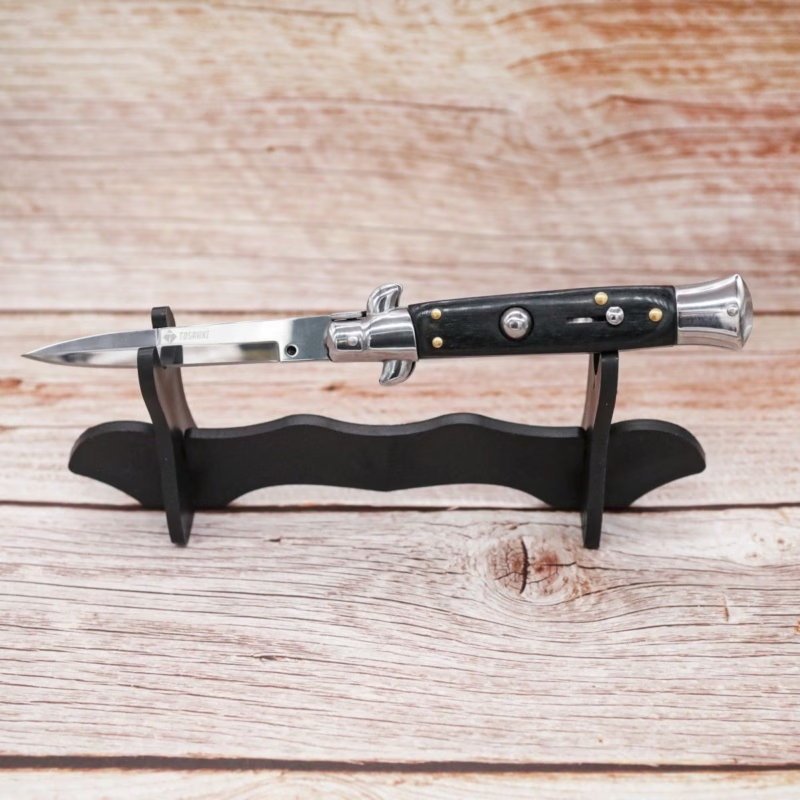
- Switchblades – legal for adults since July 1, 2022; concealed carry legalized as of July 1, 2023. Supplying switchblades to minors remains a Class 1 misdemeanor under § 18.2-309
- Ballistic knives – blade ejected by spring/explosive charge; possession and sale are largely prohibited under Virginia Code § 18.2-311.
Carry Regulations
Open Carry
Virginia generally permits open carry of most knives, including large fixed blades. However, local ordinances may impose stricter rules in urban areas, so always check municipal regulations. Exceptions include airports, where statewide rules supersede local law.
Concealed Carry
Carrying knives hidden from view is more regulated:
- Permitted for concealed carry: pocket knives under 3 inches, other folding knives, and switchblades (as of 2023).
- Prohibited for concealed carry: dirks, bowie knives, stilettos, ballistic knives, machetes, razors, throwing stars, and similar weapons.
⚠️ “Hidden from common observation” includes handbags, backpacks, or briefcases.
The following table summarizes the legality of concealed carry for various types of knives under Virginia state law:
| Knife Type | Legality of Concealed Carry (General) |
| Dirk | Prohibited |
| Bowie Knife | Prohibited |
| Stiletto | Prohibited |
| Ballistic Knife | Prohibited |
| Machete | Prohibited |
| Razor | Prohibited |
| Throwing Star | Prohibited |
| Oriental Dart | Prohibited |
| Switchblade Knife | Legal (as of July 1, 2023) |
| Pocket Knife (< 3″) | Generally Legal |
| Other Folding Knives | Generally Legal |
| Fixed Blade Knives | Legal if not a prohibited type |
It is important to note the inclusion of “any weapon of like kind” in the list of prohibited concealed weapons. This clause introduces a degree of ambiguity, as it is not explicitly defined in the statute. The determination of whether a particular knife falls under this category may depend on factors such as its design, intended use, and similarity to the enumerated prohibited weapons.
Restricted Locations
Certain areas have stricter knife laws for public safety:
- Airports: Uniform statewide restrictions; only small folding knives are permitted in terminals
- Schools & Childcare Centers: Only pocket knives with folding blades <3 inches allowed. Prohibited knives include larger folding knives and fixed blades.
- Religious Worship: Carrying dangerous knives like bowie knives or daggers is prohibited unless justified.
- Courthouses: Same as schools; pocket knives under 3 inches are exceptions.
Brandishing Laws
Virginia law prohibits displaying knives in a threatening manner:
- Blade ≥12 inches, brandished to intimidate → Class 1 misdemeanor.
- Same act near schools (within 1,000 feet) → Class 6 felony.
- Self-defense exceptions apply.
Sale and Transfer Restrictions
- Supplying ballistic knives, switchblades, dirks, or bowie knives to minors → Class 1 misdemeanor.
- These laws aim to prevent dangerous knives from being accessible to individuals under 18.
Exceptions to Knife Laws
Certain professions and activities have exemptions:
- Law enforcement & military personnel – can carry knives as part of duty.
- Knife collectors – may transport unloaded knives to exhibitions.
- Hunting activities – knives permitted under hunting regulations.
- Mail carriers – allowed to carry knives while performing duty.
Blade Length Considerations
- No general statewide limit for blade length, except in sensitive locations (schools, courthouses, airports): <3 inches.
- Brandishing laws apply to blades ≥12 inches.
- Measuring blade length should follow standard guidelines (e.g., American Knife & Tool Institute recommendations).
Penalties for Violating Knife Laws
- First offense concealed carry of prohibited knife: Class 1 misdemeanor, up to 12 months jail and/or $2,500 fine.
- Second offense: Class 6 felony, 1–5 years prison, $2,500 fine.
- Third/subsequent offenses: Class 5 felony, 1–10 years prison, $2,500 fine.
- Possession on school property or supplying prohibited knives to minors: Class 1 misdemeanor.
- Brandishing a ≥12-inch blade near schools: Class 6 felony.
Recent Legislative Updates (2022–2023)
- Switchblades: Ownership legalized for adults (July 1, 2022).
- Concealed carry of switchblades: Legalized (July 1, 2023, House Bill 2298, signed by Governor Glenn Youngkin).
- Laws reflect a shift towards liberalization for adult knife owners, balancing public safety and personal rights.
Key Definitions
- Dirk: Long straight-bladed dagger or short sword.
- Bowie Knife: Large hunting knife adapted for knife-fighting, 10–15 inches.
- Stiletto: Slender thrusting dagger (common definition used in legal proceedings).
- Ballistic Knife: Blade ejected by spring/explosive mechanism (Virginia Code § 18.2-307.1).
- Switchblade: Blade opens automatically via button, spring, or device on the handle.
Conclusion
Virginia knife laws in 2026 permit a broad range of knives but impose clear restrictions on concealed carry, sensitive locations, and minors. Recent legislative changes have liberalized switchblade ownership and concealed carry for adults. Compliance with both state and local ordinances is critical to avoid serious penalties. Always consult updated statutes or legal counsel when in doubt.