
Blog
What Is MagnaCut Steel? A Complete Guide to CPM MagnaCut Knife Steel


CPM MagnaCut is a premium powder metallurgy stainless steel designed specifically for knife blades. Developed by metallurgist Dr. Larrin Thomas, MagnaCut was engineered to deliver an unusually balanced combination of corrosion resistance, toughness and edge retention.
Most knife steels force buyers to accept a compromise. A steel with extremely high wear resistance may be harder to sharpen or more likely to chip. A very tough steel may not be stainless. A highly corrosion-resistant steel may not hold an edge as long as users want.
MagnaCut was developed to reduce those compromises.
According to Crucible’s official datasheet, CPM MagnaCut achieves its performance by eliminating chromium carbides from the heat-treated microstructure and relying instead on small, hard vanadium and niobium carbides. The result is a stainless knife steel with strong toughness, useful wear resistance and excellent corrosion resistance.
Quick Answer: What Is MagnaCut Steel?
MagnaCut is a powder metallurgy stainless knife steel designed by Dr. Larrin Thomas and produced as CPM MagnaCut by Crucible Industries. It is known for combining excellent corrosion resistance with high toughness and good edge retention, making it especially attractive for everyday carry knives, outdoor knives, hunting knives and kitchen knives.
What Does CPM MagnaCut Mean?
The full name is CPM MagnaCut.
CPM refers to Crucible Particle Metallurgy, a powder metallurgy manufacturing process used to create steels with a fine, evenly distributed carbide structure.
MagnaCut is the name of the alloy developed specifically for cutting tools and knife blades.
Unlike many popular knife steels that were originally adapted from industrial applications, MagnaCut was created with knife performance as its primary goal. Its design focuses on the properties knife users care about most:
- Resistance to rust and staining.
- Resistance to chipping and breaking.
- Long-lasting cutting performance.
- Practical sharpening and maintenance.
Who Invented MagnaCut Steel?
MagnaCut was developed by Dr. Larrin Thomas, a metallurgist and the creator of Knife Steel Nerds.
Thomas designed MagnaCut after studying the relationship between toughness, wear resistance and corrosion resistance in existing knife steels. His goal was to create a stainless steel that could achieve toughness closer to high-performance non-stainless tool steels, without giving up strong rust resistance.
In his published development article, Thomas explains that a recommended MagnaCut heat treatment can produce approximately 61–62.5 HRC with balanced toughness, corrosion resistance and edge retention, while higher hardness ranges may suit fine cutting and kitchen knives.
MagnaCut Steel Composition
The chemistry of MagnaCut is one of the main reasons it performs differently from many conventional stainless knife steels.
| Element | Percentage | Purpose in the Steel |
|---|---|---|
| Carbon | 1.15% | Supports hardness and edge performance |
| Chromium | 10.7% | Provides corrosion resistance |
| Vanadium | 4.00% | Forms hard carbides for wear resistance |
| Molybdenum | 2.00% | Supports hardenability and corrosion performance |
| Niobium | 2.00% | Forms fine, hard carbides and supports wear resistance |
| Nitrogen | 0.20% | Contributes to hardness and corrosion performance |
Composition data is taken from Crucible’s CPM MagnaCut datasheet.
At first glance, MagnaCut’s 10.7% chromium may seem low compared with some stainless steels. However, the important issue is not simply how much chromium is present. It is how much chromium remains available in the steel matrix to resist corrosion after heat treatment.
Why Is MagnaCut Steel Different?
The key innovation behind MagnaCut is its carbide structure.
In many stainless knife steels, some chromium becomes tied up in chromium carbides. Those carbides can contribute to wear resistance, but they also reduce the amount of chromium available to fight corrosion. Larger carbide structures may also reduce toughness.
MagnaCut was designed so that, after proper heat treatment, it contains no chromium carbides in its microstructure. Instead, it relies on fine vanadium and niobium carbides.
According to Crucible’s datasheet, MagnaCut has approximately:
| Carbide Type | Volume |
|---|---|
| Vanadium carbide | 6.5% |
| Niobium carbide | 1.5% |
| Chromium carbide | 0% |
| Total carbide volume | 8.0% |
For comparison, Crucible reports that S35VN has approximately 13.0% total carbide volume, including 10.5% chromium carbide. This helps explain why MagnaCut can offer high toughness and corrosion resistance while still maintaining practical edge retention.
In everyday terms, MagnaCut was engineered to avoid the oversized trade-offs found in many stainless steels.
Is MagnaCut Stainless Steel?
Yes. CPM MagnaCut is a stainless steel.
Its chromium content is used efficiently because the steel is designed to avoid chromium carbide formation after heat treatment. That leaves more chromium available to support corrosion resistance.
In Crucible’s published 72-hour, 1% saltwater spray comparison, MagnaCut recorded no visible rust spots on the chart, while comparison steels such as 20CV, S45VN and S35VN showed progressively more corrosion.
However, stainless does not mean maintenance-free. Saltwater, sweat, blood, acidic food residue and long-term damp storage can still damage a blade over time. A MagnaCut knife should still be cleaned and dried after demanding use.
MagnaCut Toughness: Does It Resist Chipping?
Toughness measures how well a blade resists cracking, breaking or chipping during hard use.
This is one of MagnaCut’s strongest advantages.
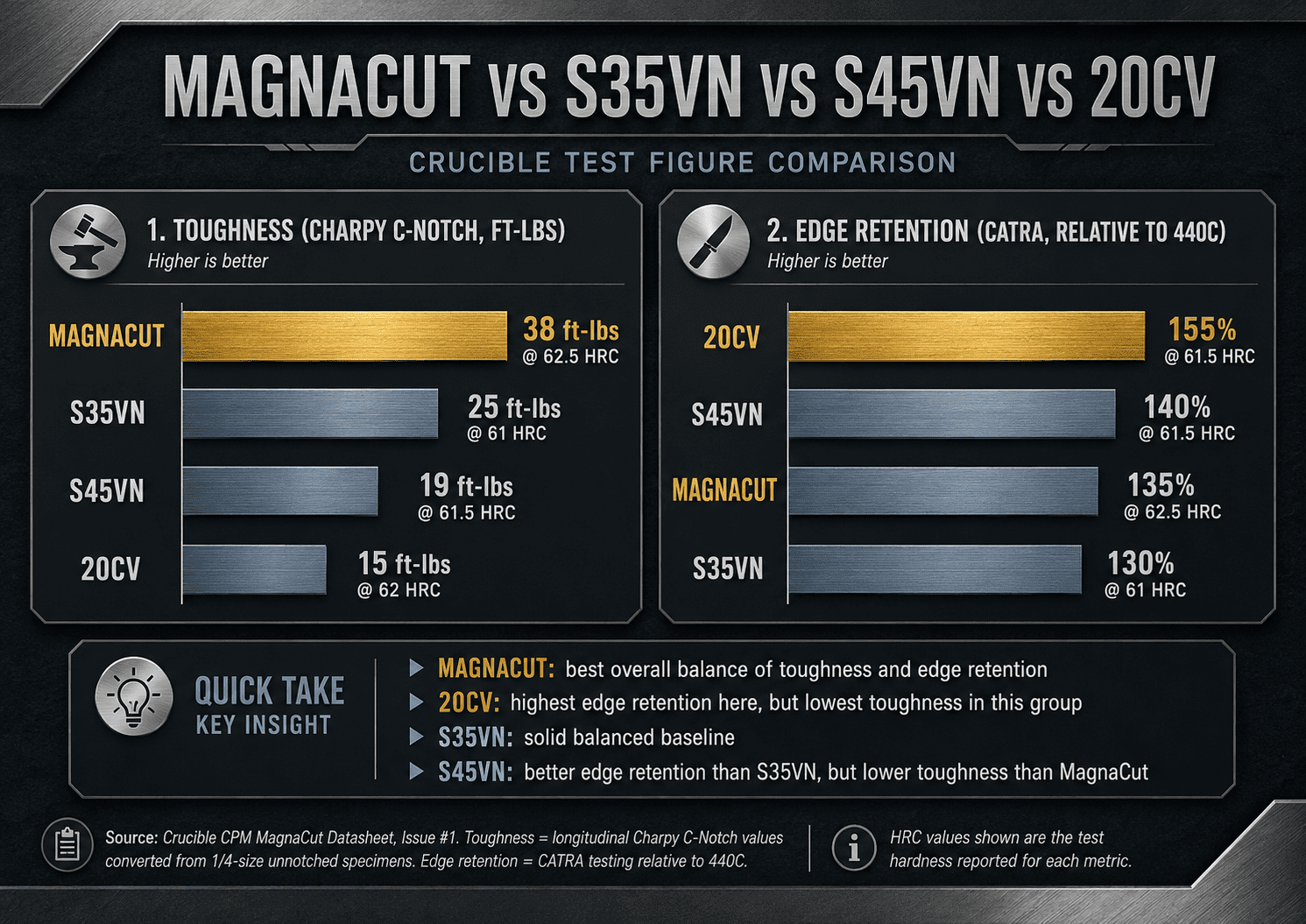
Crucible’s toughness data reports the following Charpy C-notch values:
| Steel | Hardness | Toughness |
|---|---|---|
| MagnaCut | 62.5 HRC | 38 ft-lbs |
| MagnaCut | 64 HRC | 30 ft-lbs |
| CPM 4V | 62 HRC | 36 ft-lbs |
| CPM 154 | 60 HRC | 26 ft-lbs |
| S35VN | 61 HRC | 25 ft-lbs |
| S45VN | 61.5 HRC | 19 ft-lbs |
| 20CV | 62 HRC | 15 ft-lbs |
| S90V | 61 HRC | 17 ft-lbs |
MagnaCut reaches 38 ft-lbs at 62.5 HRC, slightly exceeding CPM 4V in Crucible’s chart while also offering stainless performance.
For knife users, that can mean:
- Reduced risk of edge chipping during hard cutting tasks.
- Greater confidence in thin, efficient edge geometries.
- Strong suitability for outdoor, hunting and work knives.
- Better durability than many high-wear stainless steels.
Of course, blade geometry, heat treatment and how the knife is used matter just as much as the steel name.
MagnaCut Edge Retention: How Long Does It Stay Sharp?
MagnaCut offers good edge retention, but it is not designed to be the absolute highest-wear stainless steel on the market.
In Crucible’s CATRA edge-retention testing, measured relative to 440C, the results were:
| Steel | Hardness | Relative CATRA Edge Retention |
|---|---|---|
| S90V | 61.5 HRC | 195% |
| 20CV | 61.5 HRC | 155% |
| S45VN | 61.5 HRC | 140% |
| MagnaCut | 62.5 HRC | 135% |
| S35VN | 61 HRC | 130% |
| CPM 154 | 61 HRC | 120% |
| 440C | 56 HRC | 100% |
This data places MagnaCut slightly above S35VN and below steels such as S45VN, 20CV and S90V in pure abrasive edge-retention testing.
That does not make MagnaCut inferior. Edge retention is only one part of blade performance. A steel with very high wear resistance can be harder to sharpen or more vulnerable to chipping under rough use.
MagnaCut’s appeal is balance: it provides useful edge retention while also remaining highly corrosion-resistant and notably tough.
MagnaCut Hardness: What HRC Is Best?
The performance of any MagnaCut knife depends heavily on heat treatment.
Crucible’s recommended heat-treatment guidance lists an aim hardness of 60–63 HRC after austenitizing at 2050°F, quenching below 125°F and double tempering at 350°F for two hours each time.
Dr. Larrin Thomas has stated that a balanced treatment generally results in approximately 61–62.5 HRC, while higher hardness may be suitable for fine cutting knives where edge stability and slicing performance are priorities.
A practical buyer’s guide is:
| MagnaCut Hardness | Typical Benefit | Suitable Knife Types |
|---|---|---|
| 60–61 HRC | Higher toughness and forgiving use | Larger outdoor knives, heavy-use fixed blades |
| 61–63 HRC | Balanced edge retention and toughness | EDC folders, hunting knives, general outdoor knives |
| 63–64 HRC | Greater edge stability and cutting performance | Thin slicers, kitchen knives, precision cutters |
Hardness alone does not guarantee performance. Blade thickness, edge angle, grind, heat-treatment quality and intended use all affect how a knife performs.
MagnaCut vs S35VN
S35VN has long been a popular premium steel for folding knives and everyday carry blades. It offers solid corrosion resistance, reasonable toughness and good sharpening characteristics.
MagnaCut generally offers:
- Higher toughness at comparable hardness.
- Better corrosion resistance in Crucible’s published comparison.
- Similar to slightly higher CATRA edge-retention performance, depending on hardness.
Crucible reports MagnaCut at 38 ft-lbs toughness at 62.5 HRC, compared with 25 ft-lbs for S35VN at 61 HRC. In CATRA testing, MagnaCut scored 135% relative to 440C, compared with 130% for S35VN.
For users who like the balanced nature of S35VN but want improved corrosion resistance and toughness, MagnaCut is a compelling upgrade.
MagnaCut vs S45VN
S45VN was developed as an evolution of S35VN, offering improved corrosion resistance and edge retention.
In Crucible’s CATRA data, S45VN slightly exceeds MagnaCut in abrasive edge retention: 140% versus 135% relative to 440C. However, MagnaCut significantly exceeds S45VN in the published toughness comparison: 38 ft-lbs versus 19 ft-lbs at similar hardness levels.
Choose S45VN when slightly higher abrasive wear performance matters most.
Choose MagnaCut when you want stronger resistance to corrosion and chipping in an all-around knife.
MagnaCut vs 20CV and Similar High-Wear Stainless Steels
Steels such as CPM 20CV are popular because they offer high wear resistance and long slicing edge retention.
In Crucible’s test data, 20CV outperforms MagnaCut in CATRA testing: 155% versus 135% relative to 440C. But MagnaCut performs far better in toughness testing: 38 ft-lbs at 62.5 HRC versus 15 ft-lbs for 20CV at 62 HRC.
That makes the difference fairly practical:
- Choose a high-wear stainless steel such as 20CV when prolonged abrasive slicing is the priority.
- Choose MagnaCut when you want a tougher, more corrosion-resistant blade that is less likely to chip during harder or less predictable use.
What Are the Advantages of MagnaCut Steel?
What Are the Advantages of MagnaCut Steel?
1. Excellent Corrosion Resistance
MagnaCut is an excellent choice for humid environments, outdoor carry, food preparation, fishing, hunting and situations where moisture exposure is likely.
2. High Toughness for a Stainless Steel
Its fine carbide structure allows it to resist edge damage better than many premium stainless steels.
3. Good Edge Retention
MagnaCut is not the highest edge-retention steel available, but it performs well enough for most EDC, outdoor and kitchen applications.
4. Flexible Heat Treatment
Knife makers can tune MagnaCut for toughness-focused outdoor knives or harder, thinner precision cutters.
5. Practical All-Around Performance
Instead of maximizing one category while sacrificing another, MagnaCut performs strongly across several important knife-use categories.
Are There Any Disadvantages to MagnaCut Steel?
No steel is perfect for every user.
It Is Usually More Expensive
MagnaCut is a premium steel. Knives made from it often cost more than comparable models made from entry-level or mid-range stainless steels.
Heat Treatment Matters
A knife labeled “MagnaCut” is not automatically excellent. Poor heat treatment or unsuitable blade geometry can limit performance.
It Is Not the Highest Edge-Retention Steel
Users who mainly cut cardboard, rope or other abrasive materials may prefer steels designed for maximum wear resistance, accepting lower toughness or more difficult sharpening.
Availability Can Vary
Not every knife design is available in MagnaCut, and popular models may sell out quickly.
What Is MagnaCut Steel Best Used For?
MagnaCut is suitable for a wide variety of knife types because of its balanced performance.
Everyday Carry Knives
For EDC use, MagnaCut provides corrosion resistance against sweat and humidity, while retaining enough toughness for daily cutting tasks.
Outdoor and Camping Knives
Outdoor knives are often exposed to moisture, dirt and impact. MagnaCut’s corrosion resistance and toughness make it well suited to unpredictable field use.
Hunting Knives
A hunting knife may encounter moisture, blood, cartilage and repeated cutting. MagnaCut is appealing because it offers practical edge retention with reduced concern about corrosion.
Fishing and Marine-Adjacent Use
MagnaCut’s high corrosion resistance makes it attractive for wet environments. Even so, saltwater-exposed blades should always be rinsed, cleaned and dried.
Kitchen Knives
At higher hardness levels and with thin blade geometry, MagnaCut can be an excellent choice for high-performance kitchen knives that need stain resistance and edge stability.
How to Choose a Good MagnaCut Knife
Buying a MagnaCut knife involves more than checking the blade-steel label.
Look for the following information:
Published Hardness
A reputable manufacturer should ideally disclose the target HRC range. For general-purpose MagnaCut knives, approximately 61–63 HRC is a sensible balanced range.
Heat-Treatment Transparency
Steel performance depends on how it is heat treated. Manufacturers that disclose their hardness targets or testing process give buyers more useful information.
Blade Geometry
A thin, well-designed edge can outperform a thicker blade made from a theoretically “better” steel. Choose the blade shape and grind for your actual tasks.
Intended Use
A compact EDC folder, hunting knife, survival knife and chef’s knife require different design priorities. MagnaCut is versatile, but the complete knife still matters more than the steel alone.
Manufacturer Reputation
Look for consistent quality control, accurate specifications and practical warranty support.
How to Sharpen MagnaCut Steel
MagnaCut is a premium steel containing hard vanadium and niobium carbides, so quality sharpening abrasives are recommended.
For routine sharpening:
- Clean the blade before sharpening.
- Use diamond or CBN stones for efficient material removal.
- Maintain a consistent sharpening angle appropriate for the knife’s use.
- Finish with a finer stone or strop for the edge style you prefer.
- Avoid excessive pressure, which can make sharpening less controlled.
An EDC or outdoor knife may benefit from a durable working edge, while a kitchen knife may be finished to a finer, more refined edge.
How to Care for a MagnaCut Knife
MagnaCut is highly corrosion-resistant, but proper care still matters.
After use:
- Wipe the blade clean and dry.
- Rinse after exposure to saltwater, blood or acidic foods.
- Avoid leaving the knife wet inside a sheath.
- Store the knife clean and dry.
- Use a food-safe protective oil on kitchen or hunting knives when appropriate.
- Check folding knife pivots and locking mechanisms for debris.
Good maintenance protects more than the blade steel. It also preserves the handle, hardware, pivot and lock system.
Is MagnaCut Steel Worth It?
For many knife users, yes.
MagnaCut is worth considering when you want a premium knife steel that performs well across several important categories rather than maximizing only one. It is especially attractive for buyers who need:
- Stainless performance in wet or humid conditions.
- Strong resistance to chipping.
- Good edge retention without extremely difficult sharpening.
- One versatile knife for regular carry or outdoor use.
However, buyers focused purely on maximum abrasive edge retention may still prefer higher-wear steels. Likewise, buyers on a limited budget can find excellent practical performance from less expensive steels.
The best knife steel is not simply the newest or most expensive steel. It is the steel, heat treatment and blade design that best match how you actually use your knife.
Frequently Asked Questions About MagnaCut Steel
Is MagnaCut better than S35VN?
MagnaCut generally offers higher toughness and better corrosion resistance than S35VN, while providing similar or slightly higher edge retention in Crucible’s published tests. For a balanced premium knife, MagnaCut is often the stronger overall choice.
Is MagnaCut hard to sharpen?
MagnaCut is not as easy to sharpen as simpler stainless steels, but it is manageable with quality diamond or CBN sharpening stones. Its sharpening difficulty is generally reasonable for a premium powder metallurgy knife steel.
Does MagnaCut rust?
MagnaCut is highly corrosion-resistant, but no knife steel should be treated as completely rust-proof. Saltwater, sweat, blood and damp storage can still create corrosion risks if the blade is neglected.
What hardness should MagnaCut be?
For many EDC, outdoor and hunting knives, a range around 61–63 HRC offers balanced performance. Thinner kitchen and precision cutting knives may be run harder, depending on the maker’s design and heat treatment.
Is MagnaCut good for an EDC knife?
Yes. MagnaCut is well suited to EDC knives because it combines corrosion resistance, toughness and reliable edge performance in a blade that can handle everyday exposure to sweat, humidity and regular cutting tasks.
Is MagnaCut good for hunting knives?
Yes. MagnaCut is an excellent option for hunting knives because it resists corrosion, maintains a useful edge and offers strong resistance to chipping under field-use conditions.
Is MagnaCut a super steel?
“Super steel” is an informal marketing term rather than a technical category. MagnaCut is accurately described as a premium powder metallurgy stainless knife steel with an unusually strong balance of performance properties.
Final Thoughts: Why MagnaCut Matters
CPM MagnaCut is important because it was designed specifically around the needs of knife users. Rather than pursuing maximum edge retention at the cost of toughness, or corrosion resistance at the cost of cutting performance, MagnaCut delivers a carefully balanced combination of all three.
For EDC enthusiasts, hunters, outdoor users and cooks, that balance makes MagnaCut one of the most practical premium stainless knife steels currently available.
When choosing a MagnaCut knife, pay attention not only to the steel name but also to the heat treatment, hardness, edge geometry and reputation of the manufacturer. A well-designed knife made from properly heat-treated MagnaCut can deliver dependable cutting performance in demanding real-world conditions.